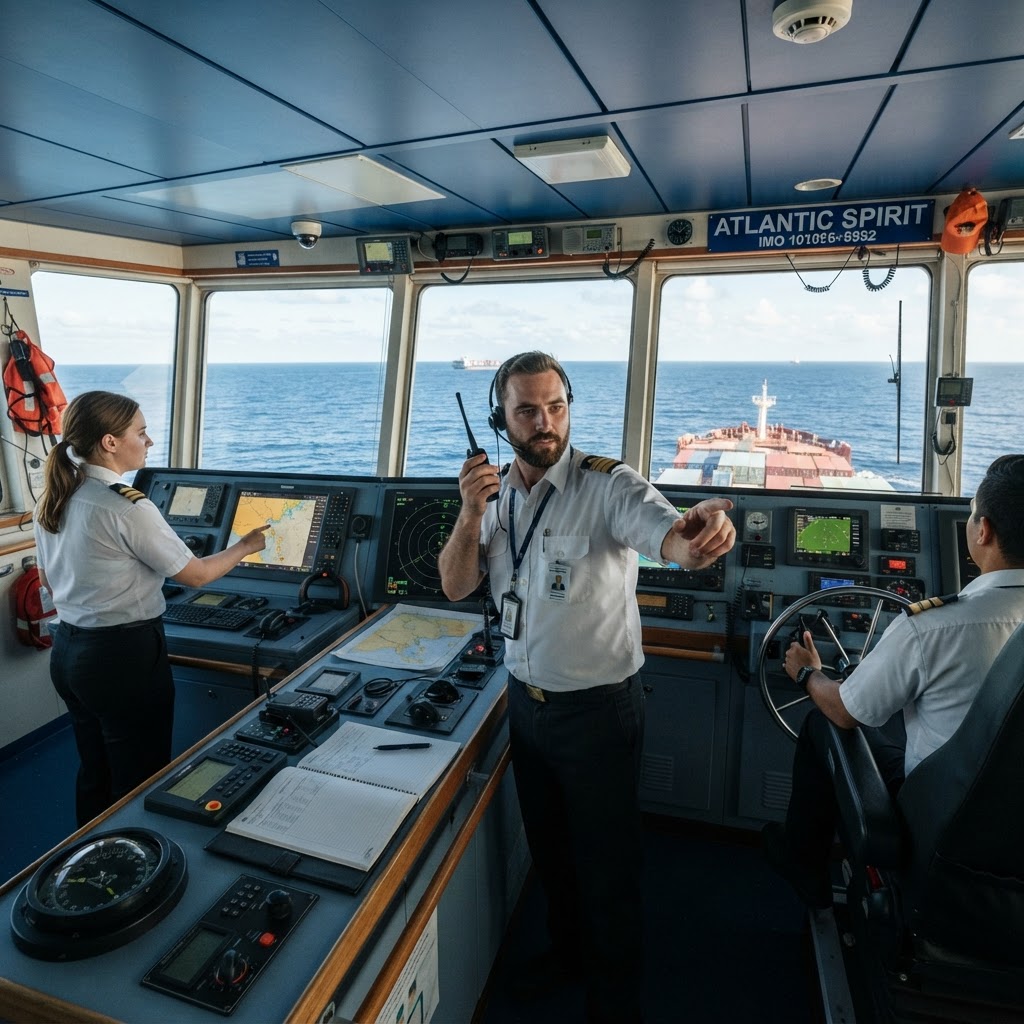
Pass your MCA orals first time. Unlimited mock orals, on demand.
OOW Prep helps you pass your MCA Officer of the Watch oral exam first time. Sit unlimited mock orals on demand, work through 5,000 syllabus questions covering COLREGS, ship stability, navigation, buoyage, GMDSS, meteorology, cargo operations, and seamanship — and get instant feedback that tells you exactly where you'll get caught out. Every answer is verified against the official MCA syllabus.
What is the MCA OOW Oral Exam?
The MCA Officer of the Watch oral exam is a verbal examination administered by the UK Maritime and Coastguard Agency (MCA). It assesses whether a deck officer has the knowledge, competence, and judgement to hold an OOW Certificate of Competency. The examiner probes across the full syllabus — COLREGS, ship stability, navigation, buoyage, electronic navigation, watchkeeping, ship handling, emergency response, GMDSS, meteorology, cargo work, pollution prevention, and maritime law — asking scenario-based questions and challenging vague or incomplete answers, just like a real bridge watchkeeping situation.
How OOW Prep Works
1. Practise questions, topic by topic
Work through 5,000 multiple choice questions covering the full MCA OOW syllabus — COLREGS, stability, navigation, buoyage, and more. Track every answer with spaced repetition that resurfaces your weakest topics so your study time is spent where it matters most.
2. Sit unlimited mock orals — anytime
Your 24/7 AI examiner asks probing follow-up questions, challenges weak answers, and marks you to real MCA oral exam standards. Every answer is verified against the official syllabus, so you know exactly where you'll get caught out before the real thing.
3. Track your weak areas
Your composite OOW Success Rating combines multiple-choice and oral exam performance, highlighting the exact topics to focus on next. Watch your rating climb as your weak areas improve.
Key Topics Covered in the OOW Syllabus
-
COLREGS
— International Regulations for Preventing Collisions at Sea, including rule numbers, lights, shapes, and sound signals
-
Ship Stability & Seaworthiness
— transverse and longitudinal stability, hydrostatics, trim calculations, free surface effect, flotation, buoyancy, and load lines
-
Navigation & Passage Planning
— coastal, ocean, and celestial navigation, chartwork, position fixing, and routeing
-
Tides & Tidal Calculations
— tidal streams, standard ports, secondary ports, and tidal height calculations
-
Sailings
— plane, parallel, and Mercator sailings
-
Buoyage & Aids to Navigation
— IALA buoyage system, lateral and cardinal marks
-
Electronic Navigation & Radar
— ARPA, ECDIS, AIS, compass errors (magnetic and gyro)
-
Watchkeeping & Bridge Resource Management
— watchkeeping at sea, anchor, and port, BRM principles
-
Ship Handling & Seamanship
— anchoring, berthing, heavy weather, shipboard safety, and emergency procedures
-
Emergency Response & Firefighting
— emergency and crisis management, firefighting, and survival
-
GMDSS & Maritime Communications
— Global Maritime Distress and Safety System, VHF, and distress procedures
-
Meteorology & Weather Routing
— weather systems, synoptic charts, and weather routing
-
Cargo Operations
— general cargo, bulk cargo (IMSBC Code), dangerous goods (IMDG Code), and tanker operations
-
Pollution Prevention & MARPOL
— MARPOL annexes, shipboard oil pollution emergency plans, and environmental compliance
-
Maritime Law & Regulations
— ISM Code, ISPS Code, Maritime Labour Convention (MLC), and maritime law advanced
-
Leadership & Management
— bridge management supervisory, passage planning management level
Certification Tracks Supported
OOW Prep supports four MCA certification tracks, each with a tailored question bank and syllabus coverage:
-
OOW <3000 GT
— Officer of the Watch for vessels under 3000 gross tonnage
-
OOW Unlimited
— Officer of the Watch for vessels of unlimited tonnage
-
Chief Mate <3000 GT
— Chief Mate for vessels under 3000 gross tonnage
-
Chief Mate Unlimited
— Chief Mate for vessels of unlimited tonnage
Practice OOW Oral Exam Questions
Prepare for your OOW orals with realistic scenario-based questions and instant AI feedback. Our question bank covers every topic in the MCA OOW syllabus for both 3000 GT and unlimited certification. Practice topic-by-topic or take full timed mock exams under exam conditions. Each question includes a detailed explanation and the correct answer, so you understand not just what's right but why it's right.
Unlimited Mock Orals with an AI Examiner
Your virtual OOW examiner is available 24/7. It asks probing follow-up questions, challenges vague answers, and marks you to real MCA oral exam standards — every answer verified against the official syllabus, just like sitting in front of a real examiner at the MCA orals. Topics include harbour approaches in restricted visibility, collision avoidance situations, stability scenarios, emergency procedures, and GMDSS operations. After each session you receive a pass or fail verdict with a breakdown of strengths, weaknesses, and specific improvement advice.
Timed Mock Exams
Sit full timed mock exams under realistic conditions. Choose from 30-minute and 60-minute formats covering the entire OOW syllabus. Your composite OOW Success Rating combines multiple-choice and oral performance, and three passing AI Examiner sessions at 70% or above on Full Syllabus earns you "Real Exam Ready" status.
Track Your Progress
Every quiz, mock exam, and oral session is saved to your account. See your average score, exams completed, and topics that need more practice versus topics where you're performing well. Spaced repetition resurfaces questions you've struggled with, so your weak areas improve over time without manual review. Bookmarks let you save tricky questions for later, and study mode lets you review the full question bank with explanations.
Free vs Premium
Start free with no credit card required. Free accounts get 5 MCQ questions per day and one mock exam per day, plus a 4-question free oral exam simulator with instant scoring. Premium unlocks unlimited AI oral exam sessions, the full 5,000 question bank, timed 30 and 60-minute mock exams, advanced weak-area feedback, bookmarks, study mode, and leaderboard ranking — for £9.99 per month, cancel anytime.
Why Choose OOW Prep?
-
Created by maritime professionals with over 25 years of experience
-
5,000 syllabus-mapped questions verified against the official MCA OOW syllabus
-
24/7 AI oral examiner that probes and challenges like a real MCA examiner
-
Spaced repetition that targets your weakest topics automatically
-
Full coverage of OOW <3000 GT, OOW Unlimited, and Chief Mate certification tracks
-
Instant feedback on every answer with detailed explanations
-
Track your progress and watch your weak areas improve week over week
Frequently Asked Questions
What is the MCA OOW oral exam?
The MCA Officer of the Watch oral exam is a verbal examination administered by the Maritime and Coastguard Agency to assess a candidate's knowledge and competence before issuing an OOW Certificate of Competency. It covers navigation, COLREGS, ship stability, seamanship, buoyage, GMDSS, meteorology, cargo operations, and emergency response.
How many practice questions does OOW Prep include?
OOW Prep includes 5,000 syllabus-mapped multiple choice questions covering the full MCA OOW syllabus for both <3000 GT and Unlimited certification tracks, plus Chief Mate oral exam preparation.
Can I practise a mock oral exam online for free?
Yes. OOW Prep offers a free 4-question AI oral exam simulator with instant scoring and feedback — no signup or credit card required. Premium subscribers get unlimited mock oral sessions with probing follow-up questions marked to MCA standards.
Does OOW Prep cover the OOW Unlimited and <3000 GT certifications?
Yes. The platform supports OOW <3000 GT, OOW Unlimited, Chief Mate <3000 GT, and Chief Mate Unlimited certification tracks, each with tailored question banks and syllabus coverage.
What topics are covered in the OOW Prep question bank?
Topics include COLREGS, ship stability and seaworthiness, navigation and passage planning, IALA buoyage, electronic navigation and radar, watchkeeping and bridge resource management, ship handling and seamanship, emergency response, GMDSS, meteorology, cargo operations, pollution prevention, and maritime law including ISM, ISPS, and MLC.
How does the AI oral examiner work?
The AI examiner conducts a realistic mock oral exam by asking scenario-based questions across the MCA OOW syllabus. It asks probing follow-up questions when answers are vague, challenges weak responses, and delivers a pass or fail verdict with a score, strengths, weaknesses, and specific improvement advice — mirroring the experience of sitting the real MCA oral exam.
How much does OOW Prep cost?
OOW Prep is free to start with no credit card required. Free accounts include 5 MCQ questions per day and one mock exam per day. Premium is £9.99 per month and unlocks unlimited AI oral exam sessions, the full 5,000 question bank, timed mock exams, advanced weak-area feedback, and leaderboard ranking — cancel anytime.
Can I use OOW Prep on my phone?
Yes. OOW Prep is fully responsive and works on mobile, tablet, and desktop. It is also available as a native mobile app on iOS and Android.
Start Your OOW Exam Prep Today
Sign up free to access 5 MCQ questions per day and one mock exam per day, or upgrade to Premium for unlimited AI oral exam sessions, the full 5,000 question bank, timed 30 and 60-minute mock exams, advanced weak-area feedback, and leaderboard ranking. Your virtual examiner is ready — are you?