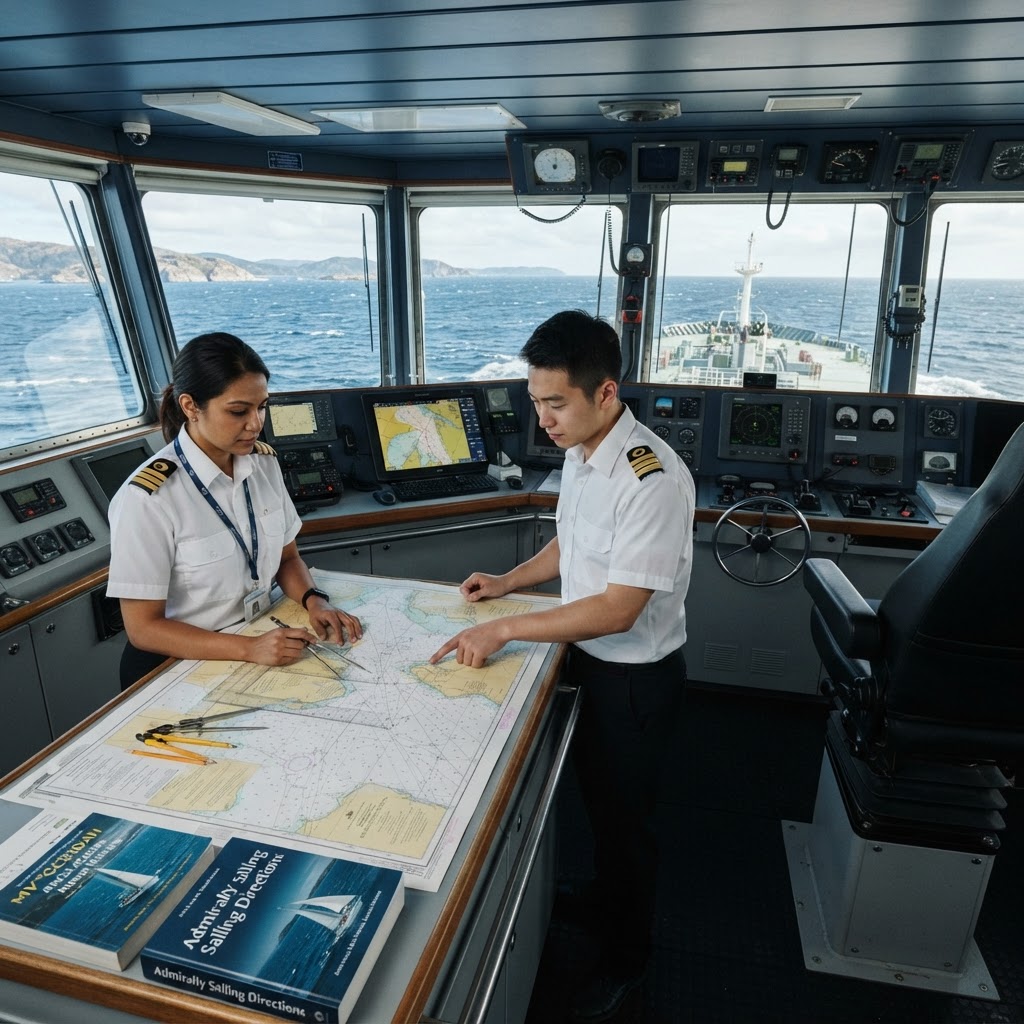
ECDIS Passage Planning: How to Cross-Reference Safety Contours for Your MCA Oral Exam
The Importance of Safety Contours in ECDIS Passage Planning
When asked by an MCA examiner, "What is the appropriate safety measure regarding the use of ECDIS for passage planning?", your answer must be direct and technically precise: You must always cross-reference the ECDIS safety contours against up-to-date, independent nautical charts (paper or back-up digital) to ensure that the depth data is accurate and the safety settings are appropriate for the vessel's specific draft and under-keel clearance.
For an Officer of the Watch (OOW) or a Chief Mate candidate sitting an MCA oral exam for an Unlimited 3000GT certificate, this question tests your understanding of the "human in the loop" requirement. Relying solely on the ECDIS computer without verification is a common cause of failure, as examiners want to see that you understand the limitations of digital hydrographic data.
Why Examiners Ask This Question
The transition from paper charts to ECDIS has changed the nature of passage planning, but the core responsibility remains the same. The examiner is checking for three key competencies:
- Verification of Data: Understanding that ECDIS depth contours are only as good as the underlying survey data.
- Situational Awareness: Ensuring you know the difference between the 'Safety Contour' and the 'Safety Depth'.
- Redundancy: Demonstrating that you do not treat the ECDIS as infallible.
Step-by-Step: Validating Your ECDIS Passage Plan
To pass this section of your oral exam, follow this logical framework when explaining your planning process:
1. Verification Against Official Sources
Before finalizing the plan, compare the ECDIS ENC (Electronic Navigational Chart) data against the latest Notice to Mariners (NTMs) and, where available, paper charts of the same scale. ECDIS is not just a screen; it is a database that requires constant updates to remain valid.
2. Setting the Safety Contour
During your planning, you must manually calculate your Safety Contour. The formula generally follows:
- Static Draft + Squat + Under Keel Clearance (UKC) Policy - Tidal Height (if applicable) = Safety Contour.
Pro Tip for the Exam: Emphasize that the ECDIS safety contour is the boundary between safe and unsafe water. If the chart survey data is poor (high 'Zone of Confidence' or ZOC), you should manually increase the safety contour to add a layer of caution.
3. Cross-Checking Zones of Confidence (CATZOC)
Modern ECDIS displays the quality of the survey data via CATZOC symbols. If the ENC shows a low-quality survey in an area where you intend to pass, you must cross-reference this with the paper chart or a secondary navigation system. Never assume the ECDIS is correct in remote or less-surveyed regions.
Common Pitfalls for Candidates
- Confusing Safety Depth with Safety Contour: Remember that the Safety Contour is a line, while the Safety Depth is a spot-sounding parameter. Mixing these up is a major red flag for an examiner.
- Blind Reliance on 'Auto-Settings': Many candidates fail because they rely on the ECDIS default settings. Always tell the examiner that you verify these settings based on the vessel's current draft and the specific environmental conditions.
- Ignoring the Back-up: If the examiner asks about the "appropriate safety measure," don't forget to mention that the ECDIS must be used in conjunction with a secondary system or back-up paper chart arrangement as required by the SOLAS V/19 regulations.
Practical Exam Advice for Chief Mates
If you are sitting for Chief Mate, the examiner expects a higher level of oversight. You should be prepared to discuss the Audit Trail of your passage plan. Mention that you check the ECDIS settings of your OOWs during your own passage planning review.
"Sir/Madam, as part of the management level duties, I ensure that all safety parameters in the ECDIS are cross-referenced against the Admiralty sailing directions and paper chart archives to confirm that the automated safety contour is not just a machine output, but a verified boundary for our vessel's deep draft."
Conclusion: Key Takeaways
Navigational safety in the modern era relies on your ability to synthesize data from multiple sources. To excel in your MCA oral exam:
- Always emphasize cross-referencing to confirm digital data.
- Understand the math behind your safety contour.
- Keep the CATZOC (Zone of Confidence) in mind when navigating in areas with questionable hydrographic history.
- Treat ECDIS as a tool, not a replacement for your professional judgment as an Officer of the Watch.
Mastering this question shows the examiner that you are a competent, safety-conscious navigator who understands that the digital age requires even more vigilance, not less.