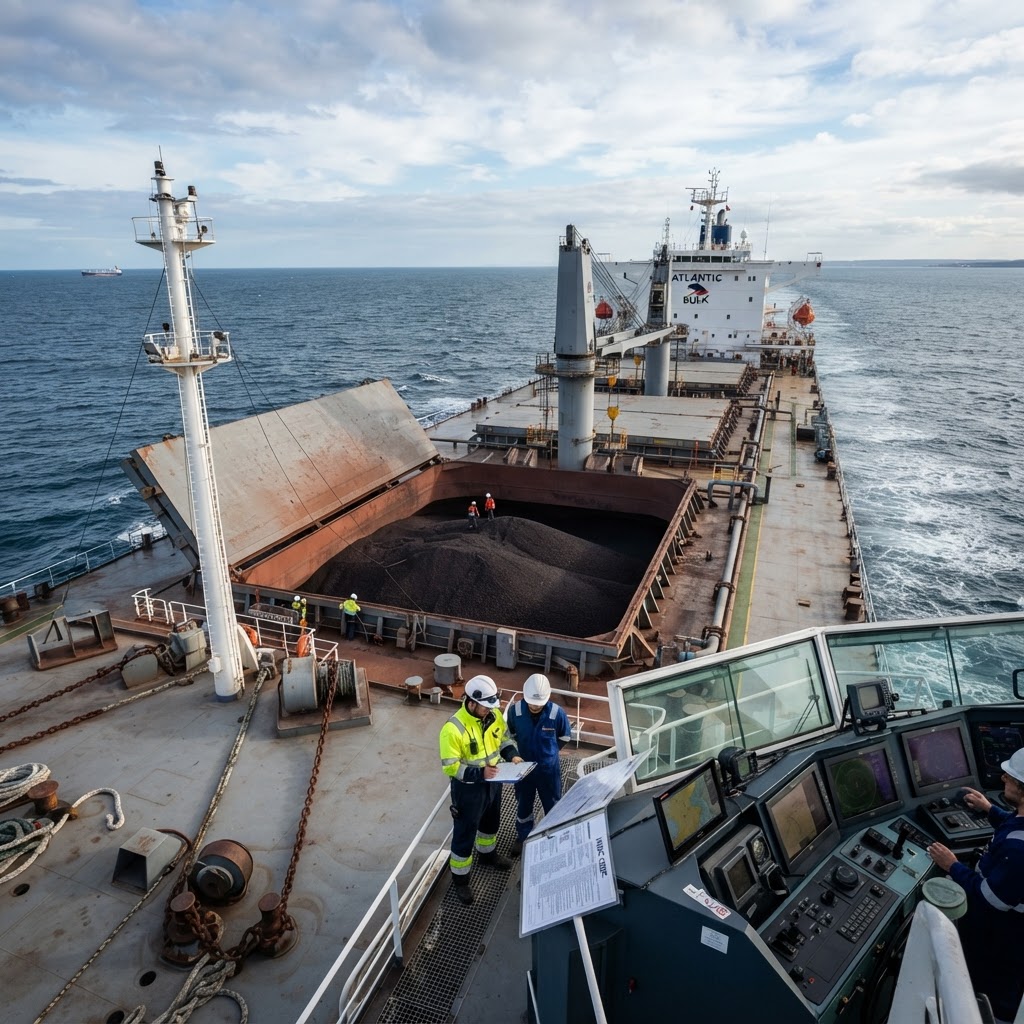
IMSBC Code Cargo Loading: Which Procedure is NOT Required Before Loading Liquefiable Cargo?
Understanding Liquefiable Cargo Procedures for the MCA Oral Exam
When facing your OOW oral exam or Chief Mate assessment, you will inevitably be tested on your knowledge of the International Maritime Solid Bulk Cargoes (IMSBC) Code. A classic "trick" question that examiners use to test your fundamental understanding of cargo operations is: "Which of the following is NOT a procedure required before loading liquefiable cargo as per the IMSBC Code?" The correct answer is: Undertaking a draft survey. While a draft survey is a critical part of commercial cargo operations for calculating the weight of cargo loaded, it is not a safety procedure stipulated by the IMSBC Code for the specific purpose of preventing liquefaction.
Why This Question Matters for Your Oral Examination
Examiners are not just looking for you to recite the IMSBC Code; they are testing your ability to distinguish between commercial operations and safety-critical compliance. For an Officer of the Watch or a Chief Mate on a vessel of 3000GT or Unlimited tonnage, understanding the distinction between cargo security (liquefaction risk) and cargo quantity (draft survey) is essential. If you confuse the two, it signals to the examiner that you do not fully grasp the physical hazards of solid bulk cargoes.
The Importance of Moisture Testing and Hold Inspections
Unlike a draft survey, which measures the amount of cargo on board, the IMSBC Code focuses on the physical state of the cargo to prevent catastrophic stability loss. The following procedures are mandatory before loading Group A cargoes (liquefiable cargoes):
- Moisture Testing: The Master must ensure that the cargo's Transportable Moisture Limit (TML) has been tested and that the actual moisture content is below this limit.
- Hold Cleanliness and Dryness: Holds must be inspected to ensure they are clean, dry, and free of residues from previous cargoes. Any standing water or moisture can initiate liquefaction.
- Bilge Protection: Bilges must be protected and tested to ensure they are functional but do not allow moisture to enter the cargo space.
- Documentation Check: The shipper must provide a signed certificate stating the TML and the actual moisture content of the cargo.
Practical Examples and Common Pitfalls
During your MCA oral exam, the examiner might present a scenario where you have a ship alongside and you are preparing to load nickel ore. If you suggest performing a draft survey as the primary safety control, you will be flagged as failing to prioritize the IMSBC requirements.
Common Pitfalls:
- Confusing Commercial vs. Statutory: Many candidates assume that because a draft survey is done before loading, it is a statutory safety requirement under the IMSBC. It is a commercial requirement, not a safety-critical procedure under the code.
- Overlooking TML Certification: Candidates often focus on the physical loading plan but fail to emphasize the legal requirement for the Shipper's Declaration and the TML certificate.
- Ignoring the "Why": If you cannot explain that liquefaction occurs due to cyclic loading (vibration/rolling) in the presence of excess moisture, the examiner will dig deeper into your stability knowledge.
Exam Tips for the OOW and Chief Mate Candidates
To excel in your MCA oral exam, follow these tips when discussing bulk cargoes:
- Prioritize Safety over Quantity: If asked about loading procedures, always mention the IMSBC Code compliance (TML, moisture, documentation) before mentioning commercial procedures like draft surveys or stowage factors.
- Use Proper Terminology: Refer to the "Shipper’s Declaration," "Transportable Moisture Limit (TML)," and "Flow Moisture Point (FMP)."
- Stay Calm with Trick Questions: If an examiner asks what is required before loading liquefiable cargo, and you immediately mention a draft survey, take a breath. Clarify that while a draft survey is standard practice, it is not an IMSBC safety requirement.
- Know Your Vessel: Whether you are on a 3000GT vessel or working towards an Unlimited license, the principles of the IMSBC remain identical. The scale of the ship does not change the physical danger of liquefaction.
Conclusion
To pass your examination, you must demonstrate a deep understanding of cargo safety. Remember that while a draft survey is performed during cargo operations, it is not a pre-loading requirement dictated by the IMSBC Code to manage the risk of liquefaction. Focus your responses on moisture testing, hold inspections, and the verification of the TML. By separating commercial operational tasks from statutory safety requirements, you will show the examiner that you are ready for the responsibilities of a Chief Mate or Officer of the Watch.