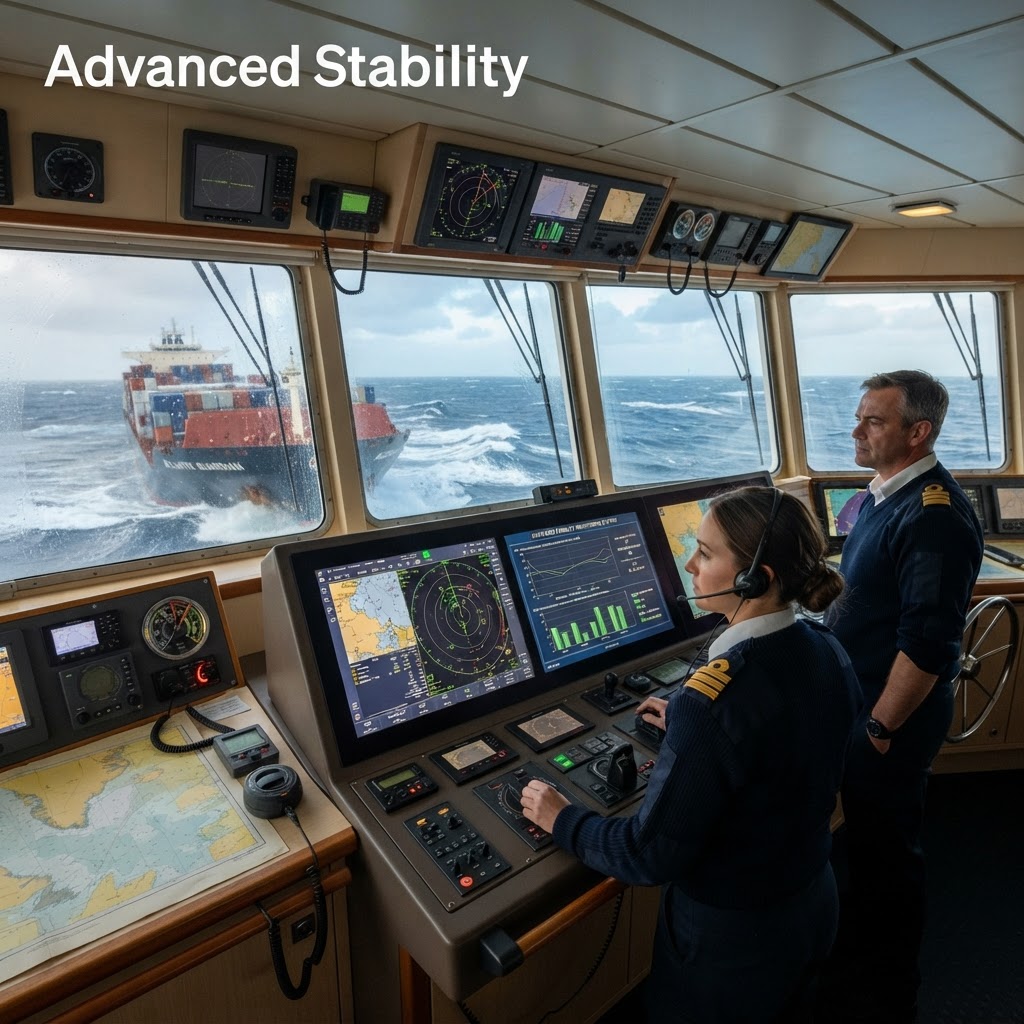
Understanding Angle of Loll: A Guide for MCA OOW and Chief Mate Oral Exams
Direct Answer: The Key to Recovery Limits
In assessing a damaged ship's stability after flooding, the essential concept for understanding recovery limits is the angle of loll. Flooding can reduce GM sharply — through the free surface of water in the damaged compartment and, if water lies high in the ship, a rise in G. If GM becomes negative, the ship cannot stay upright and heels until the centre of buoyancy moves far enough to give zero righting lever (GZ). That angle is the angle of loll. Recognising it, and knowing how to correct it safely, is what separates a recoverable ship from one on the verge of capsizing.
Why This Matters for Your MCA Oral Exam
For candidates sitting the OOW oral exam or the Chief Mate assessment, examiners prioritise stability questions because they relate directly to safety of life at sea. Whether you are aiming for your Unlimited certificate or working on a vessel over 3000GT, diagnosing a loll correctly is a must-pass competency. The examiner wants to see that you understand the ship is not heeled by an external force (like wind) or an off-centre weight, but has lost her initial stability.
The Dynamics of Angle of Loll
With negative GM, the ship cannot remain upright. As she heels, the centre of buoyancy moves towards the low side until it is vertically below the centre of gravity. At that angle the ship finds a new, temporary position of equilibrium. She may lie at that angle on either side, and may flop from one side to the other.
Key Concepts to Articulate
- Negative GM: The ship is unstable in the upright. She will not return to upright on her own.
- Righting Levers (GZ): For a ship with negative GM, the GZ curve is negative between upright and the angle of loll, crosses zero at the angle of loll, and is positive beyond it.
- Critical Limits: At the angle of loll the remaining range of stability and dynamic stability are much reduced. Further flooding, cargo shift or heavy weather can lead to capsize.
Practical Procedures: What the Examiner Expects
When an examiner asks about a damaged ship, they are testing your decision-making. Follow this structured approach:
- Verify the State: Confirm it is a loll and not a list. A list is caused by off-centre weight with positive GM. A loll is caused by negative GM. Signs of loll include the ship lying at the same angle to either side, flopping over, and a long, slow, sluggish roll about the angle of heel.
- Remove Free Surface: Remove or reduce free surface wherever possible, and remove any weight high in the ship (for example water on deck, or ice).
- Lower G: Add weight low down, typically by ballasting double bottom tanks. Fill a small, divided tank on the low side first, so the extra free surface is small and the added weight does not cause the ship to flop over violently to the other side. Then fill the corresponding tank on the high side.
- Caution: Never try to correct a loll by moving weight from the low side to the high side. With negative GM, that can make the ship flop over to the opposite side, often to a larger angle, with a dangerous lurch.
Common Pitfalls for OOW and Chief Mate Candidates
Many candidates fail to distinguish between list and loll.
- The List Trap: If you treat a loll like a list (by shifting weight to the high side), the ship can lurch over to the other side, potentially further than before.
- Ignoring Free Surface: Slack tanks are the 'silent killer' in a damaged condition. Always mention managing liquid in tanks, and remember that filling a tank creates free surface until it is pressed up.
- Not Knowing the Curve: You may not be asked to calculate the angle of loll, but you should be able to sketch the GZ curve for a negative GM condition and show where it crosses the axis.
Exam Tips for Success
- Stay Calm and Systematic: The examiner values a candidate who doesn't rush into potentially dangerous corrective action.
- Use Proper Terminology: Use terms like 'negative GM', 'righting lever', 'centre of buoyancy', and 'free surface effect' accurately.
- Be Prepared for the 'What If': The examiner may ask, "What happens when you start filling the double bottom?" Explain that the angle may briefly increase as free surface is created, before G lowers and the ship comes upright.
Conclusion
Understanding the angle of loll is critical for any Officer of the Watch or Chief Mate. Remember that it represents a ship that has lost her initial stability. By recognising loll from negative GM, removing free surface and high weight, and lowering G starting on the low side, you demonstrate the technical knowledge required to keep the ship safe.
Updated 25 October 2026: corrected the caution on shifting weight (never from the low side to the high side) and added the safe ballasting sequence for correcting a loll.