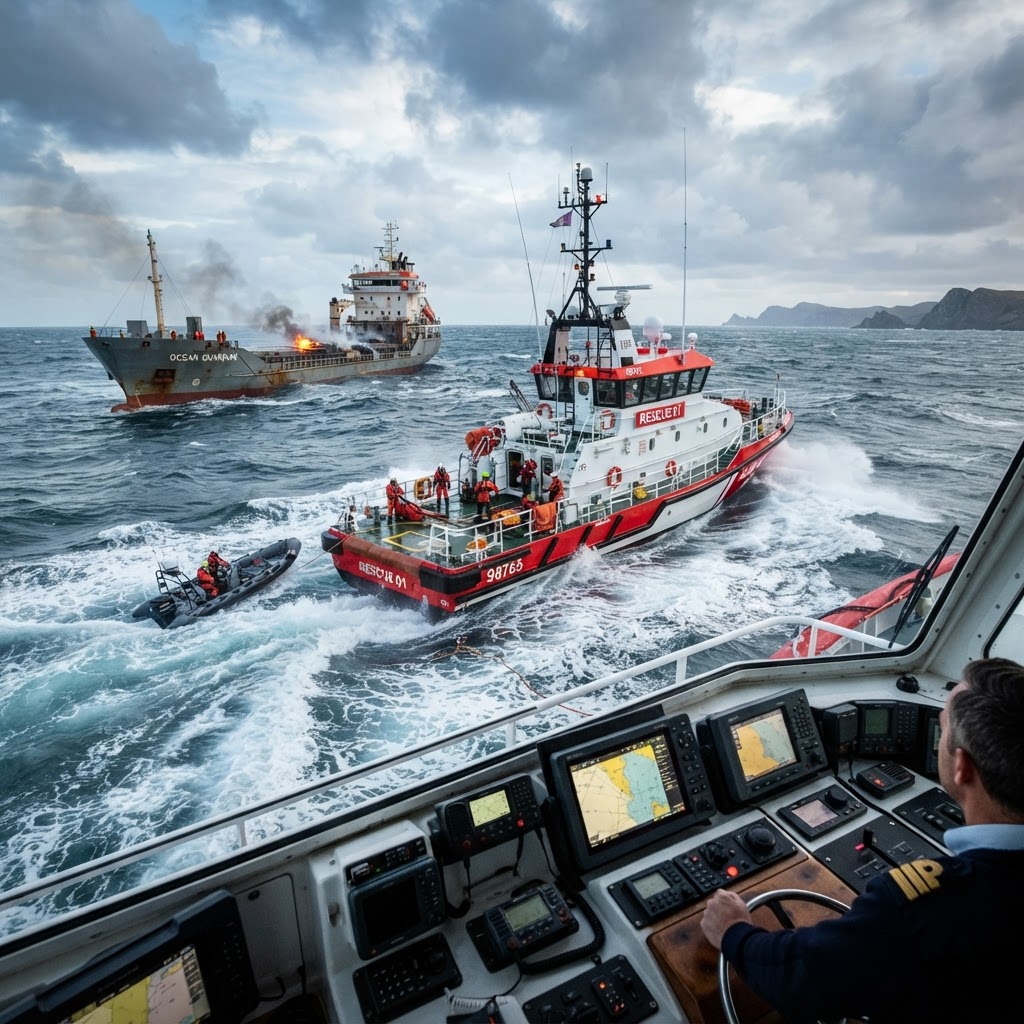
What Does the MAYDAY Prefix Mean in VHF Communications? MCA Oral Exam Guide
Understanding the MAYDAY Distress Signal
When you are sitting for your OOW oral exam or your Chief Mate assessment, the examiner is testing not just your theoretical knowledge, but your ability to react decisively in high-pressure scenarios. A fundamental question you may encounter is: "What does the MAYDAY prefix indicate when received on VHF Channel 16?"
The short, precise answer is: MAYDAY indicates that a vessel, aircraft or person is threatened by grave and imminent danger and requests immediate assistance.
Why This Question Matters for Your MCA Oral Exam
For an Officer of the Watch, VHF communications are the lifeblood of maritime safety. An examiner asks this to make sure you understand the absolute priority of the distress signal. If you hesitate when defining MAYDAY, it suggests you may struggle to prioritise communications when a real crisis occurs on the bridge.
The Anatomy of the MAYDAY Call
Under GMDSS procedures and the Radio Regulations, MAYDAY is the distress signal and has absolute priority over all other communications. When you receive a distress call, the Master has an obligation to proceed with all speed to assist, under SOLAS Chapter V, Regulation 33, unless unable to do so or released from that obligation.
Key Characteristics of a MAYDAY Call:
- Absolute Priority: All stations hearing it must stop any transmission that could interfere with distress traffic.
- Grave and Imminent Danger: The threat must be to life or to the vessel (e.g. fire, sinking, collision, or abandoning ship).
- Immediate Assistance: It is a request for help that obliges ships in a position to assist to do so.
Practical Application: What to Do as an OOW
If you hear a MAYDAY call while on watch, your response must be methodical and calm. Examiners often follow up with, "What is your immediate action on hearing a MAYDAY?"
- Listen and Record: Write down the vessel's name and call sign, position, nature of distress, assistance required and number of persons on board. Call the Master immediately.
- Keep Silence: Stop all other transmissions and do not transmit on the channel unless you are involved in the distress traffic.
- Allow the Coast Station to Respond: In coastal waters a coast station or MRCC will normally acknowledge first. Give it a short interval to do so.
- Acknowledge If You Can Assist: If no coast station acknowledges and your vessel is in a position to assist, acknowledge the MAYDAY on the Master's instructions, tell the casualty your position and ETA, and inform the MRCC by any means.
- Relay If Required: If the vessel in distress cannot transmit for herself, or the call is not acknowledged and you cannot assist, transmit a MAYDAY RELAY and alert the MRCC.
Common Pitfalls for Candidates
Many candidates lose marks by failing to distinguish between the three levels of priority. Remember the hierarchy:
- MAYDAY: Distress — grave and imminent danger. (Highest priority)
- PAN-PAN: Urgency — an urgent message concerning the safety of a vessel or person. (Second priority)
- SÉCURITÉ: Safety — an important navigational or meteorological warning. (Third priority)
Common Exam Error: Candidates often confuse a PAN-PAN with a MAYDAY, or forget that MAYDAY is only for grave and imminent danger. If a vessel has an engine failure but is not drifting toward hazards, it is not a MAYDAY; it is a PAN-PAN. Knowing the threshold for declaring a MAYDAY is essential for your MCA oral exam.
Examiner Tips for Success
If asked about the transmission itself, remember that MAYDAY is spoken three times: "MAYDAY, MAYDAY, MAYDAY." This makes sure it is heard through background noise or interference. On a GMDSS-equipped ship, a voice MAYDAY normally follows a DSC distress alert on Channel 70.
Also be prepared to discuss the MAYDAY RELAY: when it is used, who sends it, and why you must not relay a call that has already been acknowledged by a coast station. This is a favourite follow-up question for Chief Mate candidates.
Conclusion
Knowing the GMDSS priority signals is non-negotiable. MAYDAY signifies the highest level of emergency: grave and imminent danger. As you prepare for your OOW oral exam, practise the sequence of actions on hearing one — record, call the Master, keep silence, acknowledge or relay as appropriate — so you can explain it clearly and confidently.
Updated 25 October 2026: corrected the sequence of actions on hearing a MAYDAY (acknowledging if you can assist, relaying only when required).