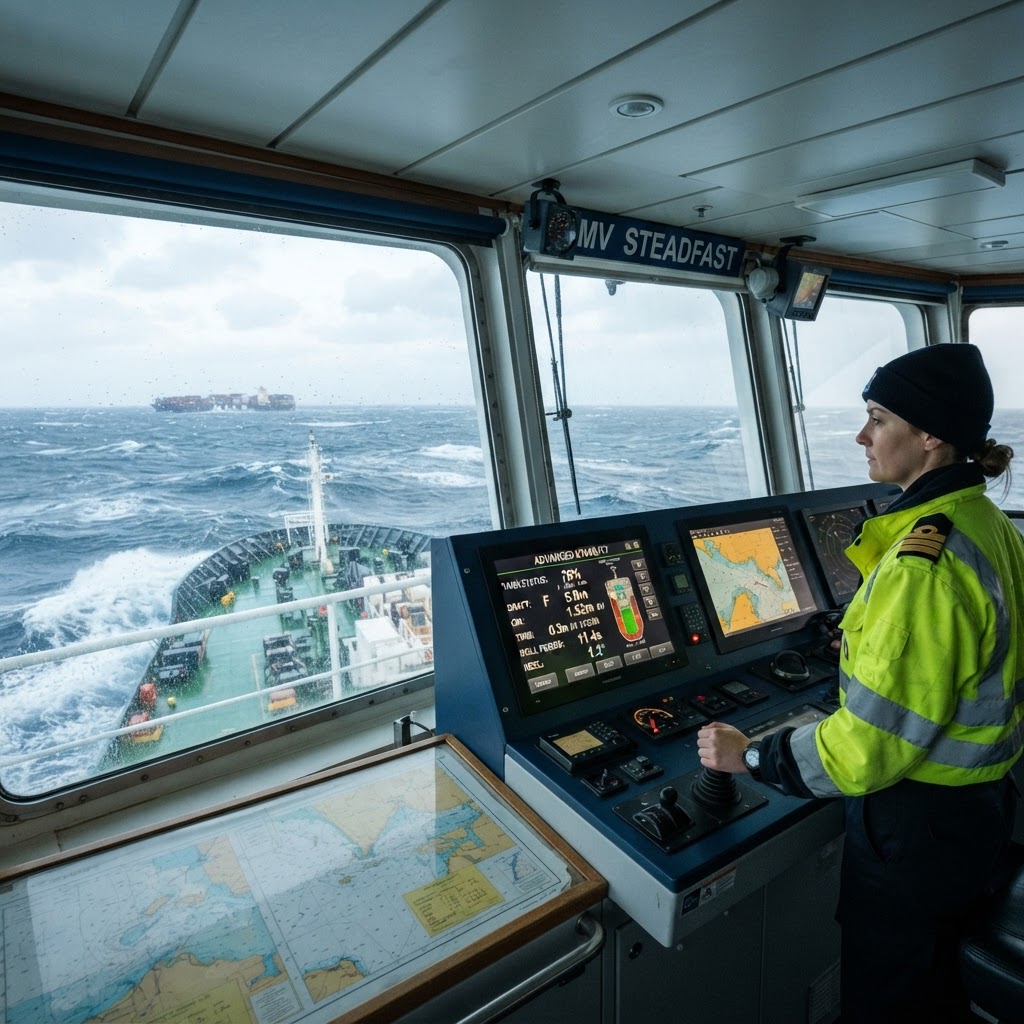
Why Is Cargo Securing Vital in Heeling Conditions? MCA Oral Exam Guide
Direct Answer for Your Oral Exam
When an examiner asks, "In terms of heeling, why is cargo securing vital during vessel operations?", the direct answer is: Cargo securing is vital because it prevents cargo from shifting. A shift moves the ship's centre of gravity off the centreline, causing a list that adds to every roll towards that side and sharply reduces the remaining (residual) stability, which can lead to capsize.
Why This Question Matters for the MCA Oral
Whether you are preparing for your OOW oral exam or the Chief Mate unlimited certificate, stability is a pillar of the assessment. Examiners focus on this question because it bridges the gap between theoretical stability (calculations) and practical seamanship. They want to ensure that as an Officer of the Watch (OOW) or a Chief Mate, you understand that stability is not just a figure on the loading computer; it depends on your diligence in following the Cargo Securing Manual (CSM).
The Dynamics of Shifting Cargo
When a vessel heels — due to wind, waves, or a turn — any cargo that is not properly secured is subjected to transverse forces. If the securing arrangements fail, the cargo slides or tips. This leads to two critical problems:
- Transverse Shift of the Centre of Gravity (G to G1): Moving weight to one side moves G off the centreline. With positive GM, the result is a list towards the side the cargo moved to. (An angle of loll is different: it is caused by negative GM, not by off-centre weight, although a shift of cargo upwards as well as sideways can make both problems worse.)
- Loss of Residual Stability: With the ship already listed, the righting lever (GZ) available on that side is much smaller, the range of stability is reduced and the deck edge immerses sooner. A sudden, violent shift can also overwhelm the ship's dynamic stability, leading to capsize.
The Importance of the Cargo Securing Manual (CSM)
During your MCA oral exam, if you are asked about securing, always reference the Cargo Securing Manual. The examiner is looking for evidence that you understand that the ship must secure cargo according to an approved manual. You should be able to discuss:
- MSL (Maximum Securing Load): The load-carrying capacity of the securing gear.
- Friction: The role of dunnage and friction mats in preventing the initial movement.
- Lashing Patterns: Why standard patterns must be followed to distribute forces correctly.
Common Pitfalls for Candidates
Candidates often lose marks by focusing only on the lashing gear while ignoring the effect on the vessel. Do not just talk about turnbuckles and wires. Connect the gear to the stability parameters. Securing is about prevention: once the cargo has shifted, the stability condition you planned for no longer exists.
Practical Application for the Chief Mate
If you are sitting for your Chief Mate Unlimited, the examiner expects a higher level of operational maturity. Discuss the impact of weather routing and pre-voyage planning. Explain how you would:
- Monitor the weather forecast to anticipate heavy rolling.
- Make sure lashings are inspected and re-tightened regularly during the voyage, not just on departure.
- Understand how a large GM (a stiff ship with a short, violent roll) increases the accelerations acting on cargo and lashings.
Exam Tips for Success
- Use Correct Terminology: Refer to the centre of gravity (KG), righting lever (GZ), list, residual stability and transverse forces.
- Stay Logical: Start with the mechanism (securing) and end with the result (stability/capsize).
- Know Your Ship: If the examiner asks, "How did you secure cargo on your last ship?", be ready with a specific example of how you used the CSM.
Conclusion
Cargo securing is not merely a deck task; it is an essential stability safeguard. By preventing the movement of cargo, you keep the centre of gravity where it was planned, so the vessel keeps enough righting energy to recover from rolling and heeling. For your MCA oral, remember: secure cargo = stable vessel = safety of life and ship.
Updated 25 October 2026: corrected the explanation of a cargo shift (off-centre weight causes a list; an angle of loll comes from negative GM).